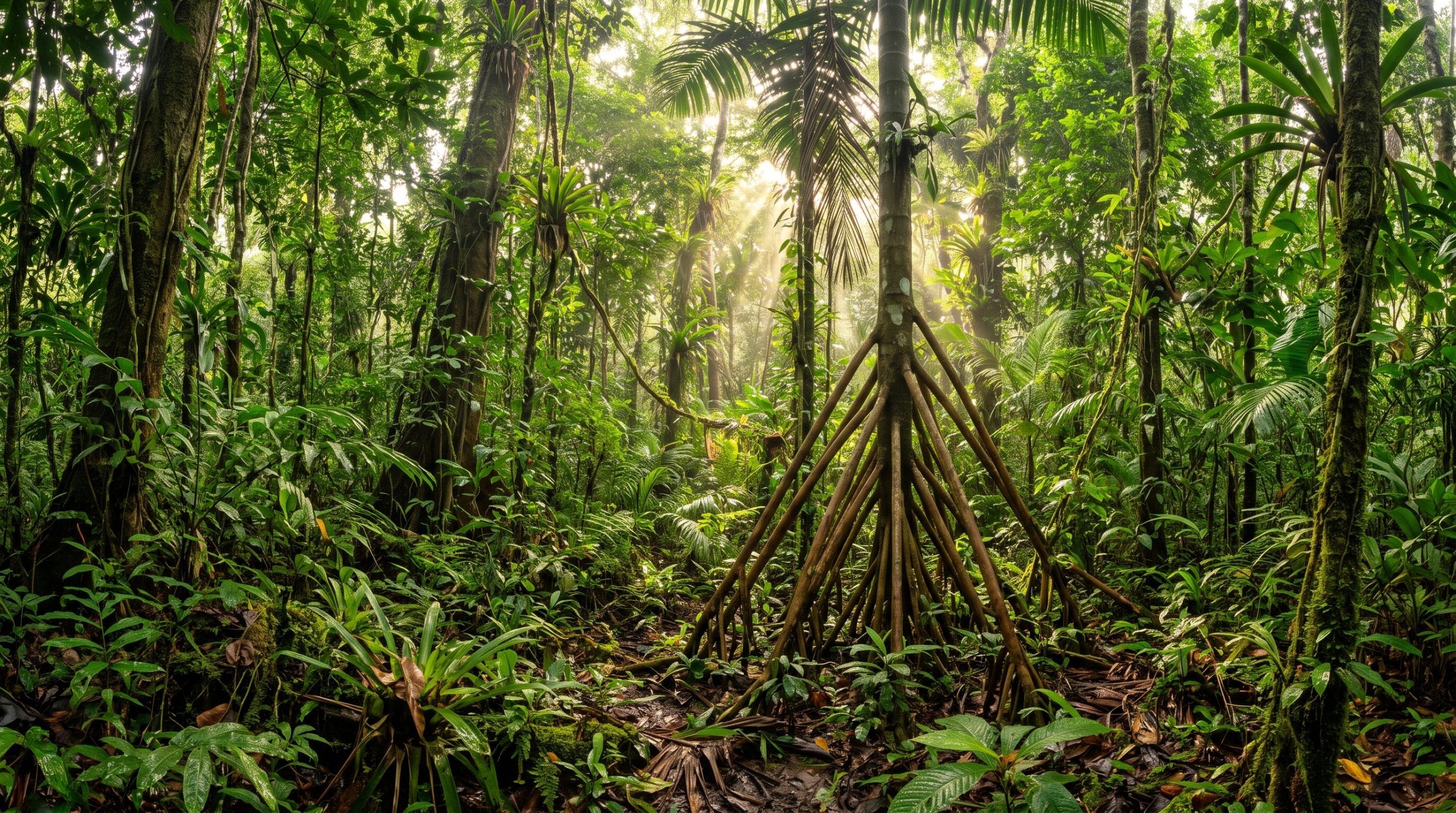
Deep inside the dense Amazon rainforest lies one of nature’s most fascinating botanic mysteries: Socratea exorrhiza, widely known as the “Walking Palm.” Unlike typical trees anchored firmly in the soil, this palm features unusual leg-like stilt roots that elevate its main trunk high above the ground. Local jungle legends claim that this tree can literally walk up to 20 meters per year in search of direct sunlight. But is this incredible story true, or just a rainforest myth?
The captivating idea of a tree migrating across the jungle floor stems directly from its peculiar root architecture. As Socratea exorrhiza grows under the dense canopy, it faces fierce competition for survival and sunlight. To adapt, the palm continuously sprouts sturdy new stilt roots outward toward available light gaps in the rainforest.
As new roots take firm hold in the soil, older roots on the shaded side slowly decay and rot away. This continuous cycle gradually shifts the base of the tree toward the sunlight over time. To a casual observer visiting years apart, it truly appears as though the tree has walked to a completely new spot.
Despite viral internet stories, modern botanists remain skeptical about whether the tree “walks” in a literal sense. Scientific studies show that while the root replacement system is a real evolutionary adaptation, actual trunk movement is extremely minimal. Most plant experts classify this phenomenon as a clever survival technique rather than active locomotion.
Regardless of the debate, the Walking Palm remains an astounding example of plant adaptation on Earth. It showcases the incredible strategies flora develop to survive in the competitive Amazon ecosystem. Would you travel into the Amazon jungle to see the Walking Palm in person? Share your thoughts in the comments below!